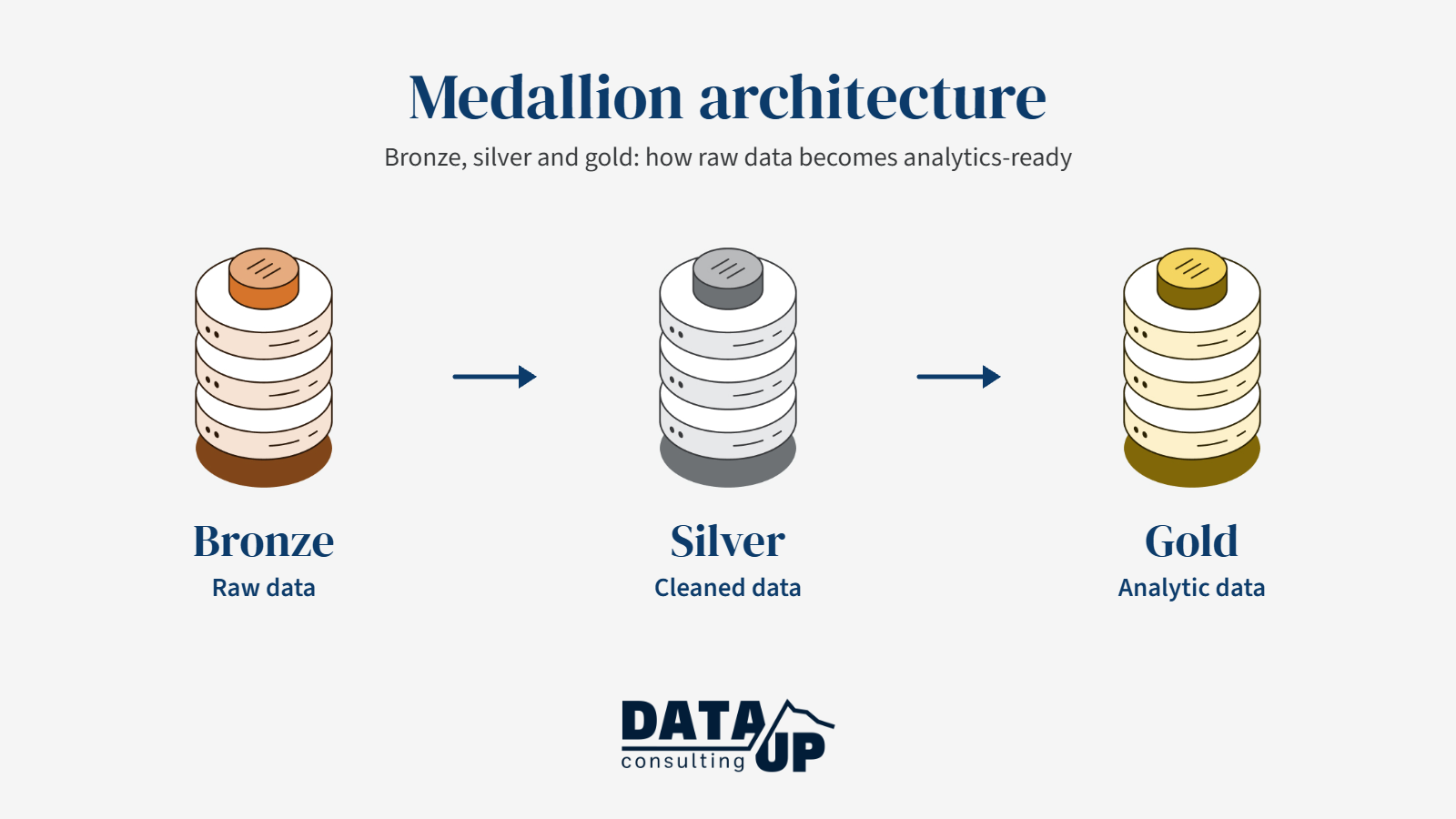
Medallion architecture is one of the most common ways to organize data in a modern data platform. If you have heard data teams talk about "bronze, silver and gold" tables, this is what they mean. Here is what medallion architecture is, how each layer works, and when it makes sense for your business.
What is medallion architecture?
Medallion architecture is a data design pattern that moves data through three layers: bronze, silver and gold. Each layer is cleaner and more useful than the one before it. Raw data lands in bronze, gets cleaned in silver, and becomes business-ready in gold, where dashboards and AI tools read from it.
It is a pattern, not a product. You can build a medallion architecture on Snowflake, Databricks, Microsoft Fabric, SQL Server, BigQuery or most other modern data platforms. The name comes from the medals: bronze, silver, gold, with quality going up at every step.
The three layers of medallion architecture
Bronze layer: raw data
The bronze layer is the landing zone for every source system. Data is loaded as-is from your ERP, CRM, finance tools, spreadsheets, files and APIs. Nothing is changed, and full history is kept.
- Purpose: a complete, untouched copy of your source data.
- What it looks like: raw tables and files (JSON, CSV, Parquet), often messy and full of duplicates.
- Why it matters: you can always trace a number back to where it came from, and reload downstream layers without going back to the source.
Silver layer: cleaned data
The silver layer is where data becomes trustworthy. Records are deduplicated, validated and shaped into consistent tables, and data from different systems is matched up, so a customer in the CRM and the same customer in finance become one record.
- Purpose: one clean source of truth for the whole company.
- What it looks like: structured tables with enforced schemas and handled missing values.
- Why it matters: data quality problems are caught here, before they reach a dashboard.
Gold layer: analytic data
The gold layer holds business-ready models built for a specific use: sales reporting, finance, operations or AI. These are usually star schemas with facts and dimensions, plus pre-calculated KPIs.
- Purpose: fast, simple data that business users and tools can trust.
- What it looks like: small, well-named tables like daily sales by location or monthly revenue by customer.
- Why it matters: DOMO, Power BI and Tableau dashboards load quickly, and everyone sees the same numbers.
Why use a medallion architecture?
- Trust: every metric can be traced from gold back through silver to the raw bronze data.
- Quality: checks between layers stop bad data before leaders see it.
- Speed: reports and AI read small, ready-made gold tables instead of raw data.
- Flexibility: new sources land in bronze without breaking the reports built on gold.
- AI readiness: clean, well-described gold data is what AI tools need to give useful answers.
Medallion architecture vs a traditional data warehouse
A traditional data warehouse often loads data straight into reporting tables, with cleaning hidden inside one large process. When a number looks wrong, it is hard to tell where it went wrong. Medallion architecture splits that work into clear steps, so each layer can be tested, fixed and reloaded on its own. Many teams use both ideas together: the gold layer is their warehouse.
Building a medallion architecture on Snowflake, DOMO and other tools
On Snowflake, the layers are usually separate schemas or databases. Snowpipe loads bronze, Dynamic Tables, Streams and Tasks or dbt build silver and gold, and secure views share gold with BI tools. We cover this in detail on our Snowflake consulting page.
In DOMO, Magic ETL and DataFlows can play the same roles, turning raw connector datasets into clean, certified datasets your cards and dashboards run on. The tools change, but the idea stays the same.
When does medallion architecture make sense?
It is a good fit when you pull data from more than a few systems, when different teams report different numbers, or when you plan to use AI on your data. For a single small data source, a simpler setup is often enough.
Frequently asked questions
Is medallion architecture only for Databricks?
No. Databricks popularized the name, but the pattern works on Snowflake, Microsoft Fabric, SQL Server, BigQuery and most modern data platforms.
Do I need all three layers?
Most teams benefit from all three. Smaller projects sometimes combine silver and gold, but keeping a raw bronze layer is almost always worth it.
How long does it take to build?
It depends on how many sources you have and how clean they are. A first set of sources can usually be live in weeks, then you add more over time.
Planning a data foundation? See our data architecture services or book a free data strategy call. We push the DataUP.


